
Media - Let's Talk
Commentary on Listening to Younger Generations Video Series #5

The subject of this commentary, following the fifth and final video of the Listening to Younger Generations series, is media. I begin with Marshall McLuhan’s idea that “the medium is the message.” McLuhan’s perspective shows us that media is not simply the communication of information and perspective. It is essentially a mediating structure defining our lives.
Modern media, as a mediating structure, exists between you and me. It is not just the information we share. It is how our relationships in the modern age are managed.
The mediating structure of media is another way to say Guy Debord’s famous statement, “The spectacle is not a collection of images, but a social relation among people, mediated by images.” The spectacle is the medium of modern communication.
Sociologist Peter Berger, writer of two important works, To Empower People: From State to Civil Society and The Social Construction of Reality: A Treatise in the Sociology of Knowledge, describes how, as human beings, we seek ways to extend our lives in the world. He writes
“Human existence is, ab initio, an ongoing externalization. As man externalizes himself, he constructs the world into which he externalizes himself. In the process of externalization, he projects his own meanings into reality. Symbolic universes, which proclaim that all reality is humanly meaningful and call upon the entire cosmos to signify the validity of human existence, constitute the farthest reaches of this projection.”
This projection of human existence finds its home in the social mediating structures that occupy our lives. We establish structures like the State, the School, the Church, the Club, and the Family to mediate our relationships with one another. These mediating structures provide us a way to form our lives in relation to others.
The additional truth is that these mediating structures are not benign. They have an external purpose that frames and develops us to be a certain way. Children grow up, resisting the parent-child structure, because they seek to break free and discover themselves. There is a natural evolution from childhood to adolescence to adulthood, which is accomplished through society’s mediating structures.
Disrupt the family through divorce, abuse, or abandonment, and the mediating structure of the family can become harmful. The disruption creates trauma and rushes adult-level pain into the child’s life.
Most of our best movies and television series are about the conflict that these mediating structures cause in society. Crime, in a certain sense, is the breaking of the enclosure of the legal mediating structures. The entire Epstein saga is a story of the perversion of the mediating structures of family, community, business, and the State. We should not be surprised when we find people violating the validated structures of society. We should also not be surprised that mental and emotional illness occurs as a result.
Marshall McLuhan’s "The Medium is the Message” describes how mediating structures define what is appropriate and inappropriate in society. The Media stands between you and me. You are more likely to believe the news account of a news reader you do not personally know than me, with whom you may have had a direct relationship. This is how the function of social control in the Culture of Simulation operates.
The medium of social media and media in general signals to us what we must believe and what is not permitted to be believed. The media serve as a mediating structure for social control.
You are reading this post on your phone or tablet. The physical medium acts as a buffer. If I were to say all of this to you in person, we could have a conversation about it as I spoke. We can still do that, but it is more difficult. You must take the initiative to reach out to me and request a private conversation.
Your reception of my presentation is not complete because you have read or heard it. If we were to have a conversation, and you told me what you think of my thoughts, we would have circumvented the mediating structures that alienate us from one another. We would have made open conversation a medium for communication between us.
If you were to print this post off and read it on the plane as you fly to another city, your thoughts may well be different. Maybe not significantly, but different enough because you have moved to a new place. Place serves as a mediating structure.
I don’t normally record my posts, but I am here. You could read it, or listen to it, or read it while I read it, and do it in your home or at a bar, or with a group of friends. All those contexts are also mediating structures that affect how we receive information through the media.
We are always surrounded by these mediating structures. They are necessary for how we live. It is important to recognize this and realize that every one of these mediating structures affects how you receive information. Learning to manage these structures is how we learn to find ourselves.
I believe the most important mediating structures are the relationships we form within our families, with friends, at work, and through community activities. Each one is a medium that conveys a message.
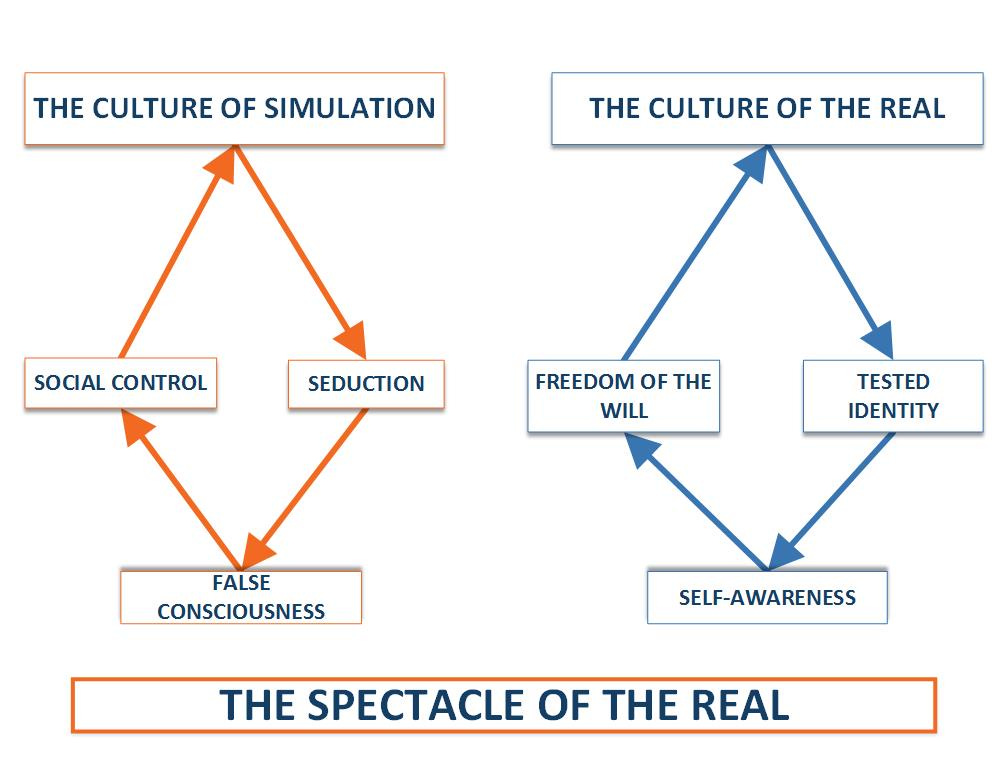
The cultures of simulation and reality are mediating structures. As a medium, they convey concepts with embedded messages. The image of each culture is a medium of communication. As a result, the image tells what we need to know.
In my post, Held Hostage in a Luxury Hotel, I demonstrate that the medium of culture affects our sense of who we are and what is possible. In one instance, we are socially controlled. In the other, we are free to choose the life we want. The medium of the image may be all that is necessary to see the difference.
I have spent my life breaking through confining mediating structures and embracing those structures that provide purpose and opportunity.
I am convinced that both older and younger generations need to be freed from mediating structures of simulation. We need to be set free to establish relationships of respect, trust, openness, and purpose.
So, let’s talk about how we can create a shared mediums where we can,
Listen.
Be Curious.
Ask Questions.
Show, don’t tell.
Appreciate and Affirm.
Say thanks.
Thank you for reading this far. Please subscribe because these ideas are taking us somewhere that I would like you to be a part of. We are creating new mediating structures.
Listening To Younger Generations Project
1. Generational Differences
2. Answer to Questions Not Asked
3. Families
4. Authenticity
5. Media
Substack Posts on Media
The Spectacle of the Real Series - https://edbrenegar.substack.com/p/the-spectacle-of-the-real-series
Held Hostage in a Luxury Hotel: The Hegemonic Character of the Culture of Simulation - https://edbrenegar.substack.com/p/held-hostage-in-a-luxury-hotel
Substack posts on Generational Memory
Generational Memory’s Impact - https://edbrenegar.substack.com/p/why-generational-memory-matters
Discovering Generational Memory - https://edbrenegar.substack.com/p/discovering-generational-memory
Recovering Generational Memory - https://edbrenegar.substack.com/p/recovering-generational-memory
Answer To Questions Never Asked - https://edbrenegar.substack.com/p/answers-to-questions-never-asked
William Faulkner’s Generational Memory - https://edbrenegar.substack.com/p/william-faulkners-generational-memory