
Generational Memory in Organizations
The Time and Reality Series


Generational Memory in Organizations.
During my consulting years, and now as I talk with people on my podcast, The Eddy Network, they are sharing their Generational Memory. When they describe something a crisis or a success, they are sharing something personal with me.
However, what they rarely tell me is how the structure of their situation worsened things. For me, it is obvious that the inhibiting factor is in how organizations are designed. The reason is that I place the person above the structure. People taking personal initiative have an impact on why people are hired to do work.
When Structure dictates behavior, you have erected the work equivalent of a prison. The compartments, the departments, the siloes, the hidden missions, and ultimately, the diminishment of human work through technology.
Even how we speak about leadership reflects the dominance of the power of the few over the service of the many.
Is leadership a role, a title, or a form of structure? Or is it a function, an activity, or an expression of how we live?
The old design adage, “Form follows Function,” is not true. In the modern organization, Function follows Form. This is a design product of the Industrial Revolution. It fits with all the different economic/political ideologies of the past three hundred years. Whether it is industrial Capitalism or Soviet or Maoism Communism, they all placed Form before the Functioning of the human person. I can accept that these were emerging forms. But they did not change.
The challenge I have faced for decades is the idea that people are endowed with a capacity for making a difference that supercedes almost every system or organizational design. Helping people understand the effect of Structure in the context of the three dimensions of leadership of the Circle of Impact is my greatest challenge.
It isn’t that people don’t believe they can change and improve. It is that the structures of society, both Social and Organizational, inhibit their growth.
If you are a business owner, a manager or a supervisor of people, ask this question.
“If my people were to fulfill their human potential, what difference would I see here?”
No one asks this question. We don’t because we only see potential in financial terms. For the business owner, people are a cost, not an asset.
Understanding How To Change
I developed the Circle of Impact based on seeing three patterns of problematic behavior.
Lack of clarity of thought.
Lack of respect and trust in relationships.
Lack of awareness of how structure affects the whole enterprise of the organization.
This simple image provides a clear way to see the interplay among the three behaviors I describe as dimensions of leadership.
The image betrays the complexity that actually exists. It is a dynamic image, not linear or static. The three dimensions are in a constant give-and-take of effect and influence.
Ideas create a consciousness of how the alignment between the three dimensions works.
Relationships create the energy exchange of agency in collaboration for the purpose of the organization.
Structure creates the environment for scaling the impact of people and their work.

I find that people can distinguish individually between Ideas, Relationships, and Structure, but have difficulty in understanding how to align them. This limitation on perspective is a product of the compartmentalization of both organizational and intellectual life.
Alignment is important because the people who work in an organization are living in all three of the dimensions at the same time. They are forced to find alignment to achieve their goals.
The singular problem is that Organizational Structure resists the intrusion of external ideas (values) and relationships (friendships) that are not governed by the structure.
We are all so close to this reality that we cannot see it. For this reason, we need to nurture our memory to discover what previous generations of people can tell us about what it was like in the past.
I remember my father coming home every night and describing his day to us. He had more good days than bad days. But the bad days were the ones that affected me. I did not go into business because of it. Yet, because of it, I ended up spending twenty years as an organizational consultant.
To see the Past is to see how we got to where we are today, to the Present. At that point, we can address the issues of alignment. I am convinced that organizations have been failing for a long time. Twenty-five years ago, I saw the collapse of the modern organizations. I have written quite a bit about it. (See below at the end of the essay.)
The questions we face are greater than institutional decline and the role of AI. They are societal ones. The answers are not unknown, though they may be ignored. As George Santayana reminded us, “Those who cannot remember the past are condemned to repeat it.”
The Culture of Generational Memory
Generational Memory is a product of the human culture of an organization.
Organizational culture develops from interactions among members of the organization. There are two forms of culture, a social one and an organization one
Social Structure operates in parallel or within the organization’s Operational Structure.
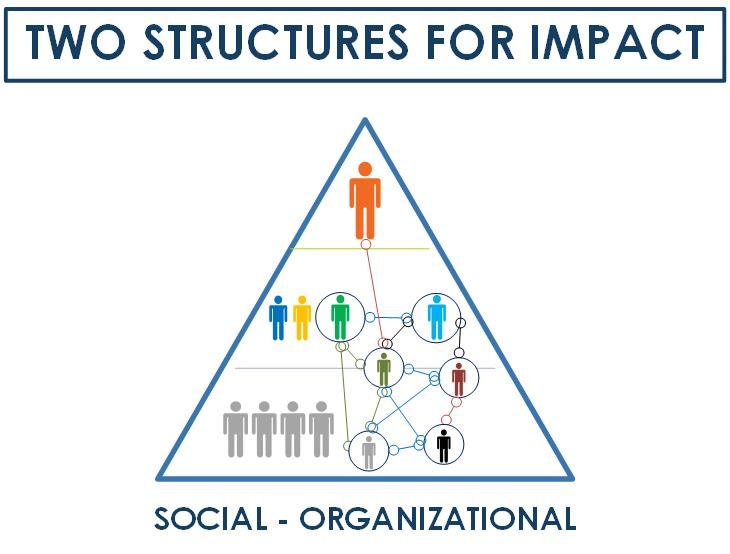
The Organizational Structure includes Products, Operations, Finance, and Governance functions. The management structure is hierarchical.
The Social Structure is collaborative, based on how people work and relate within the other structures and systems.
To uncover Generational Memory in an organization, we began by asking.
“What is the generational memory of the company?”
“Who determines what that memory is?”
Every organization has a hierarchy of power defined by the organizational chart.
The people who hold power tend not to be the longest-serving employees. They create structures that, on the surface, seem rational and operationally sound.
The siloes and compartmentalization have the result of restricting access to information and making interdepartmental communication more difficult. It means accountability is never mutual.
This is how organizational systems have evolved. It isn’t the systems of design but of perception.
Over the past three decades, network theory has helped me to see the connection between relationships and structure.
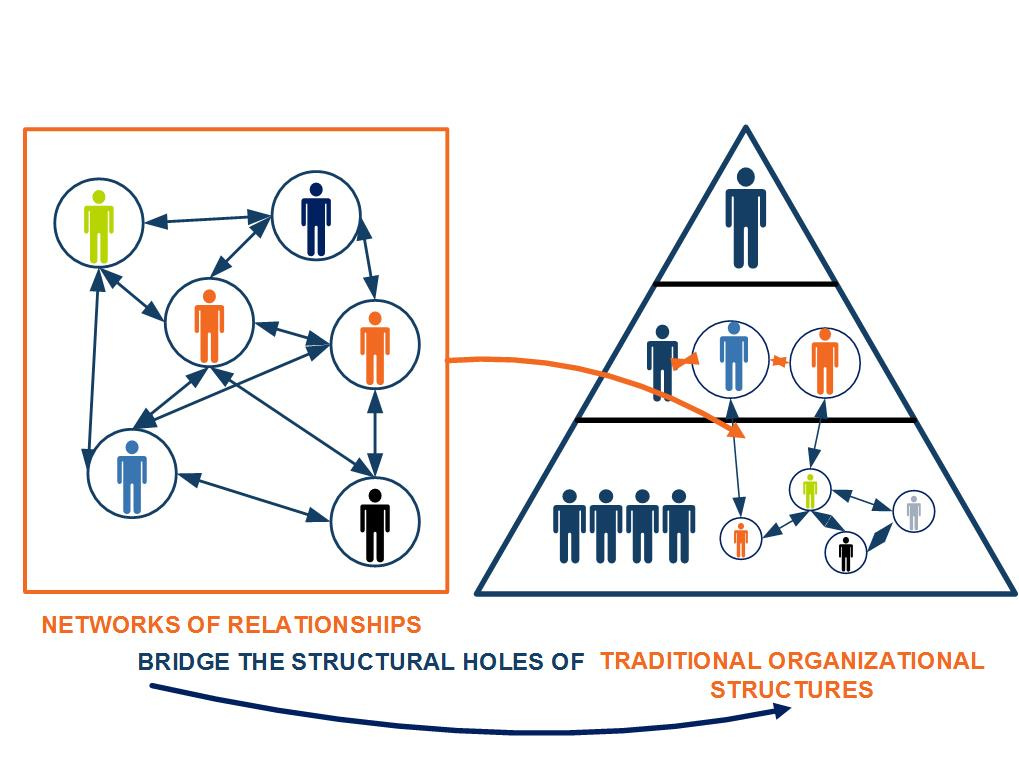
A healthy organization develops a relationship culture of shared purpose, respect, trust, and mutuality. Embedded in this dynamic is organizational memory.
“Generational Memory is a remembrance of the Past that serves to clarify and define its relationship to the Present and the Future. It is the Living History of Time. As a story is first told, it becomes a historical record. The stories of origin and belief become the memories of meaning and purpose for families and persons. It is the memory that transcends time and establishes the bond for a people to share.”
An organization’s generational memory has a very long lifespan. This story explains why.
Two decades ago, I was hired to help an organization to write a new values statement. Sounds pretty benign, doesn’t it. It was anything but irrelevant to the future of the company.
I was hired by the new CEO. He had been there four months. He followed a chief executive and some of his assistants who had persuaded the board to sell some company assets, and they received a portion of the proceeds. The board approved. When the community became aware of their morally questionable actions, they were asked to resign. This moment of awareness was not the memory, but how they function in their roles that constituted the generational memory that we addressed.
At my first meeting with the team selected to write the values statement, I began by asking this question.
“How far back in time do we have to go to when this was a happy company?”
I’m asking for their generational memory.
The union president quickly said,
“Twenty years!”
I followed with,
“What was it like then?”
He said,
“We were a family.”
So, what were they now? And what specifically had changed?
It was a very interesting process because it was clear that they couldn’t go back in time to be what they once were as a company.
While they saw themselves as a family back then, what they really were was an organization freely communicating and collaborating.
The new values statement elevated the training of middle managers to develop a culture of communication, problem-solving, and innovation at the lowest echelons of the company.
Within two years, they were recognized as one of the most trustworthy companies in the nation.
I am convinced that they always were a trustworthy company. For those twenty years, the executives of the company restricted communication, problem-solving, and innovation. They failed to kill off the culture of family. The generational memory of the longest-serving employees revitalized the company. Calling them back to when they were a company that they could be proud to serve.
This is how I describe what happens.
“There is a persistent, residual culture of values that persists because it resides in the relationships of the people.”
With this story in mind, let’s answer these questions.
“Who owns the generational memory of the company?”
Everyone.
“Who determines what that memory is?”
The shared community of employees functioning as a network of relationships.
“In an organization, what is this memory.”
It is the culture of values that binds people together to serve the company and its networks of relationships.
Generational memory is a social culture extending over time. It is how people relate to one another, want to work together, and feel pride in serving the company.
Managing Organizational Generational Memory
Recollection of the past provides a baseline for understanding how the company got to the present. Looking back, we can see how decisions made impacted how the company functioned.
Think about this in the context of AI. When an AI avatar replaces a human being, that person’s generational memory leaves the company. Even with data going back generations, AI lives in the present. Or as I have come to call it, The Eternal Present, because it acts in the present.
Generational memory is the embodied memory of past generations.
It is a relationship memory incorporating the human interaction of the members of the organization’s community. When the Union president told me that twenty years before, the company was like a family, I asked what that was like. He said,
“We did things together. Played softball. Held picnics together. We knew each other’s spouses and children by first name.”
The new CEO picked up on this early in his tenure. He would meet rank-and-file members of the company at their workplace, bringing breakfast, dressed in casual clothes, and not talking about the company, but about their families. They knew him by his first name. And he did theirs.
Building on that generational memory enabled the company to overcome the loss of community that had occurred over the previous twenty years. They were once again the trustworthy company they had once been.
Restoring Your Organization’s Generational Memory
The question is not whether you have a generational memory, but whether it is a memory shared.
I have found in many situations a bias against remembering the past. Usually, it is because strong personalities do not want to be held accountable to past precedents.
Being aware of generational memory means that we are willing to be critical of the past. Generational memory is just a remembrance of the past. You want to elevate the good and negate the bad.
The first step is simply to host social events for the people of the company. It could begin with a birthday party or a celebration of someone’s anniversary with the company. These moments of social unity matter because they signal that, at least at this moment, we are one body of people as the company.
A second step would be to conduct a project to discover what the working values of the company are. Working values are different from core values. These are descriptions of how “we” work together. You can build on these values, and even change the structure of work because of what is learned.
A third step is to have someone collect stories. Generational memories are contained in stories that people remember and share. This is especially true at the most local level within the company. If a global corporation has an office in Paducah or Singapore, the generational memory of the people who work there is for their office, not for the whole company.
Creating a generational memory is not a work product, but rather a social outcome.
Remembering and learning from the Past provides a ground for a generational memory that will inform future people, leaders, and teams in the company.
It is important to realize that everyone has a memory of their work at the company. When acknowledged, shared, and compiled, it becomes a generational memory that can better guide the company in the future.
My Writing on Organizational Structure:
Circle of Impact: Taking Personal Initiative To Ignite Change (2018)
Seeing Below The Surface of Things: The Brokenness of the Modern Organization (2020)
Where Did Trust Go?: Restoring Authority and Accountability to Organizations (2020)